
Produits d’évapotranspiration de l’IWMI#
Date de modification : Novembre 2025
Aperçu#
Aperçu#
L’évapotranspiration (ET) peut être divisée en évapotranspiration bleue (ET bleue) issue des sources d’eau bleue telles que l’eau de surface et l’eau souterraine, et en évapotranspiration verte (ET verte) issue de la pluie et de l’humidité du sol stockée utilisée par la végétation. Ces produits ont été développés par l’Institut international de gestion de l’eau (IWMI) à travers le projet DIWASA (Digital Innovation for Water Secure Africa) en utilisant les données d’ET dérivées du modèle opérationnel SSEBop (Simplified Surface Energy Balance) (Senay et al., 2013).
L’ET bleue ou ET incrémentale est une composante clé des flux d’eau bleue dans la comptabilité de l’eau. Elle prend en compte l’évaporation des champs irrigués, la transpiration des cultures irriguées et l’eau perdue par le stockage artificiel. Le produit DIWASA Blue ET inclut également l’ET de l’eau de surface (rivières, lacs et réservoirs). L’ET bleue peut être utilisée pour évaluer la productivité de l’eau dans l’agriculture irriguée, quantifier la consommation d’eau et soutenir la gestion durable des ressources en eau, en particulier dans les régions à forte pénurie d’eau.
L’ET verte ou ET de pluie est la partie de l’ET dérivée de l’eau verte, qui comprend l’humidité du sol et la pluie efficace. Elle représente une composante clé des flux d’eau dans la comptabilité de l’eau. L’ET verte se compose de l’évaporation du sol nu (humidité du sol reconstituée directement par la pluie), de la transpiration des cultures pluviales et de la végétation naturelle, et des pertes par interception des précipitations sur la végétation. Elle joue un rôle crucial dans le suivi de la sécheresse et la gestion durable de l’eau en surveillant comment la pluie soutient la croissance des plantes.
Digital Earth Africa (DE Africa) permet l’accès à ces jeux de données pour la région africaine, offrant un accès gratuit et ouvert aux données ainsi qu’aux outils associés à travers la Sandbox DE Africa.
Spécifications#
La couverture et les métadonnées pertinentes pour chacun des jeux de données peuvent être consultées sur l”Explorateur de métadonnées de DE Africa :
Un Jupyter Notebook qui démontre le chargement et l’utilisation des produits dans la Sandbox est également disponible.
Caractéristiques
Tableau 1 : Spécifications des produits ET bleue et ET verte
Spécification |
Valeur |
|---|---|
Nom du produit |
ET bleue, ET verte |
Taille de cellule - X (degrés) |
0,00952 (~1000 mètres) |
Taille de cellule - Y (degrés) |
0,00952 (~1000 mètres) |
Système de référence de coordonnées |
EPSG:4326 |
Résolution temporelle |
Mensuel |
Plage temporelle |
2003 - 2021 |
Ensemble de données parent |
Évapotranspiration de Landsat |
Fréquence de mise à jour |
Annuel |
Mesures
Tableau 2 : Mesures des produits ET bleue et ET verte
Nom du produit |
ID de la bande |
Description |
Unités |
Type de données |
Valeur No Data |
Facteur d’échelle |
|---|---|---|---|---|---|---|
ET bleue |
blueet |
ET bleue mensuelle |
mm |
Int16 |
-9999 |
0,1 |
ET verte |
greenet |
ET verte mensuelle |
mm |
Int16 |
-9999 |
0,1 |
Étendue géographique#
La couverture spatiale et temporelle des jeux de données d’ET bleue et d’ET verte peut être explorée sur l’explorateur de métadonnées de DE Africa Metadata Explorer, et les données sont disponibles pour la région ombrée en bleu de la Figure 1. Différents produits peuvent être sélectionnés dans le menu déroulant horizontal en haut de la page.
Figure 1 : ET bleue et ET verte

Traitement#
La méthode de comptabilité de l’eau (Water Accounting+, WA+) utilisée par l’IWMI emploie une approche de bilan hydrique massique, où
P correspond aux précipitations, ET est l’évapotranspiration réelle, QP désigne la percolation profonde, QS est le ruissellement de surface, et ΔSM est la variation de l’humidité du sol dans la zone racinaire au niveau du pixel. L’ET est ensuite partitionnée en ET verte et bleue en utilisant le bilan d’humidité du sol, d’abord en estimant l’ET bleue (ETb) comme suit :
\begin{equation} \begin{split} ET_b = \begin{cases} 0 & \text{si } SM_t \geq 0 \\ -SM_t & \text{si } SM_t < 0 \end{cases} \end{split} \tag{2} \end{equation}
Cette méthode suppose que lorsque l’humidité du sol dépasse la quantité fournie par les précipitations, l’humidité excédentaire provient de sources externes telles que les rivières, les eaux souterraines ou les lacs (van Eekelen et al., 2015). La composante d’ET verte (ETg) est ensuite obtenue en soustrayant l’ET bleue de l’ET totale :
Le cadre WA+ et la méthodologie de séparation de l’ET bleue et de l’ET verte à partir de l’ET totale ont été développés par Karimi et al. (2013) à l”UNESCO-IHE (IHE Delft Institute for Water Education) en collaboration avec l’IWMI et l’Organisation des Nations Unies pour l’alimentation et l’agriculture Food and Agriculture Organization (FAO).
Médias et exemples d’images#
Image 1 : Moyenne annuelle de l’ET verte (gauche) et de l’ET bleue (droite) de 2003 à 2021, calculée à partir de l’ET annuelle SSEBop.
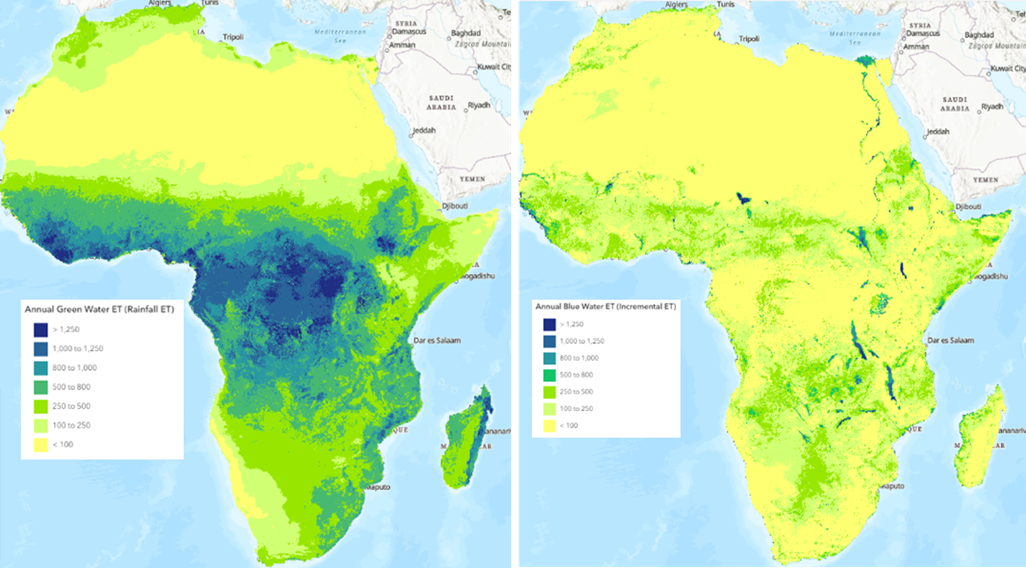
Crédit : Généré par l’équipe DIWASA de l’IWMI à partir de l’ET SSEBop.
Informations techniques#
Le jeu de données a été généré sur une grille de 1 km x 1 km, sur une base mensuelle de 2003 à 2021, couvrant l’ensemble du continent africain. La précision des jeux de données d’ET bleue et d’ET verte générés dépend de manière critique des performances du modèle SSEBop et de la méthodologie de séparation WA+. Les limites inhérentes au modèle SSEBop, telles que les erreurs du modèle et les incertitudes dans les paramètres d’entrée, ont un impact direct sur la précision des estimations de l’ET bleue et verte. De plus, la méthodologie WA+ peut introduire des erreurs. C’est particulièrement vrai dans les situations où un stockage important de l’humidité du sol, une remontée capillaire ou des sources d’eau autres que la pluie peuvent entraîner des erreurs de classification (Karimi et al., 2013, Owusu et al., 2025). La sensibilité du modèle SSEBop aux données d’entrée et aux hypothèses de paramètres a été détaillée par une analyse d’incertitude approfondie menée par Chen et al. (2016) sur plusieurs sites de tours de flux.
Références#
Chen, M., Senay, G.B., Singh, R.K., Verdin, J.P. 2016. Uncertainty analysis of the Operational Simplified Surface Energy Balance (SSEBop) model at multiple flux tower sites. Journal of Hydrology. Volume 536. 2016. Pages 384-399. ISSN 0022-1694. https://doi.org/10.1016/j.jhydrol.2016.02.026.
Senay, G.B., Bohms, S., Singh, R.K., Gowda, P.H., Velpuri, N.M., Alemu, H., and Verdin, J.P. 2013. Operational Evapotranspiration Mapping Using Remote Sensing and Weather Datasets: A New Parameterization for the SSEB Approach. Journal of the American Water Resources Association (JAWRA) 49(3): 577-591. DOI: 10.1111/jawr.12057
Karimi, P., Bastiaanssen, W. G. M., and Molden, D. 2013. Water Accounting Plus (WA+) – a water accounting procedure for complex river basins based on satellite measurements. Hydrol. Earth Syst. Sci. 17. 2459–2472. https://doi.org/10.5194/hess-17-2459-2013, 2013.
Owusu, A., Akpoti, K., Leh, M., Perera, T., Madushanka, L., Mekonnen, K., Tinonetsana, P., Tayebi, N., Escalera-Rodriguez, A.C., Fofana, R., Velpuri, N.M. 2025. Bridging scales and borders on water availability and use in the transboundary Volta River Basin: A water accounting approach. Journal of Hydrology: Regional Studies, Volume 59, 2025, 102377, ISSN 2214-5818. https://doi.org/10.1016/j.ejrh.2025.102377.
Van Eekelen, M.W., Bastiaanssen, W.G.M., Jarmain, C., Jackson, B., Ferreira, F., van der Zaag, P., Saraiva Okello, A., Bosch, J., Dye, P., Bastidas-Obando, E., Dost, R.J.J., Luxemburg, W.M.J., 2015. A novel approach to estimate direct and indirect water withdrawals from satellite measurements: A case study from the Incomati basin. Agric Ecosyst Environ 200, 126–142. https://doi.org/10.1016/J.AGEE.2014.10.023
Licence#
Les données d’ET Bleue et Verte appartiennent au domaine public et sont disponibles librement pour un usage public. Les données d’IWMI sont partagées sous une licence ouverte Creative Commons. Les utilisateurs de ces jeux de données sont encouragés à citer les articles de Karimi et al. (2013) et Owusu et al. (2025).
Remerciements#
Les produits ET Bleue et ET Verte sont générés par le projet DIWASA de l’IWMI avec le soutien financier de la fondation Helmsley Charitable Trust. L’accès aux données et le soutien régional ont été rendus possibles par Digital Earth Africa.
Accès aux données#
Amazon Web Services S3#
Les produits d’évapotranspiration de l’IWMI sont accessibles depuis le compartiment S3 associé.
Tableau 3 : Détails de l’accès aux données AWS
Détails AWS S3 |
|
|---|---|
ARN du compartiment |
|
Noms de produits |
|
Services Web OGC (OWS)#
Ce produit est disponible via OWS de DE Africa.
Tableau 4 : Détails d’accès aux données OWS.
Détails de l’OWS |
|
|---|---|
Nom |
« DE Africa Services » |
URL des services de cartographie Web (WMS) |
|
URL du service de couverture Web (WCS) |
|
Noms des calques |
|
Les détails de Digital Earth Africa OWS peuvent être trouvés sur https://ows.digitalearth.africa/.
Pour obtenir des instructions sur la façon de se connecter à OWS, consultez « ce tutoriel <../web_services/index.ipynb> ».
Open Data Cube (ODC)#
Les produits d’évapotranspiration de l’IWMI sont accessibles via l’API ODC de Digital Earth Africa, disponible via le Digital Earth Africa Sandbox.
Nom du produit ODC : iwmi_blue_et_monthly, iwmi_green_et_monthly
[ ]: